

Incentives, real running costs, five year savings, and whether 2026 is the right time to switch
Electric cars are becoming more common in care and community health work for a simple reason: mileage adds up fast, and fuel is a constant drain. When you are driving between visits all day, transport is not a lifestyle choice. It is part of the job.
But the EV conversation has started to change. The “cheap to run” message is still true in the right conditions, but the UK is also starting to talk more openly about a future where electric cars contribute to road funding in new ways. The big question for care workers and nurses is no longer “are EVs the future?” It is, “will the savings actually land in my pocket, and for how long?”
This guide breaks it down properly: what incentives exist, what the running costs look like in the real world, what a five year view can look like, and what policy changes may reshape the numbers.
The incentives that matter in 2026
1) The Electric Car Grant (upfront help is back on the table)
The UK’s Electric Car Grant is active and structured around eligibility rules, including a price threshold. Manufacturers apply for vehicle eligibility and the discount is applied at point of sale. The government guidance describes it as a banded grant for eligible EVs priced at £37,000 or below, with criteria linked to sustainability of manufacturing.
That matters for care staff because it reduces the initial “EV premium” on more affordable models, which is the barrier that stops most people, not the electricity cost.
2) Salary sacrifice (the quiet winner for nurses and larger employers)
If you work for an NHS trust or a large care organisation that offers a salary sacrifice car scheme, this can be one of the most cost-effective ways to access an EV because payments come from gross salary.
For many staff, salary sacrifice can make a new EV feel more achievable, particularly when insurance, servicing and maintenance are bundled.
3) Benefit-in-Kind (BiK) remains favourable for EVs, but it is rising slowly
For company cars, government policy has already signposted future rises in the “appropriate percentage” for zero-emission and electric vehicles.
For care staff, the important takeaway is not the exact number. It is the direction: BiK remains incentivised compared with petrol and diesel, but the tax advantage narrows over time.
4) Mileage reimbursement guidance for EVs
HMRC’s advisory electric rates are a practical reference point for employers setting reimbursement policies. The rates distinguish between home charging and public charging.
For domiciliary care, that split is crucial, because your charging situation changes the entire story.
The real cost question: home charging versus public charging
EVs can be very cheap per mile when charged at home, especially if you can use off-peak tariffs. But if you rely mostly on public rapid charging, it can become surprisingly expensive and, in some cases, more costly than a good diesel.
The care-sector reality is mixed. Some carers have driveways and a home charger, and the EV maths works beautifully. Others live in flats, terraced streets, or shared parking situations, and rely on public charging. Their EV maths can be painful.
So, when people say “EVs are cheaper”, the honest version is: EVs are cheaper when you can control your charging costs.
Mileage reimbursement options for care employers
Clear mileage policies protect staff and prevent quiet out-of-pocket costs. This table summarises common UK approaches aligned with HMRC guidance.
| Use case | Best-fit policy | HMRC reference point | What this means in practice |
|---|---|---|---|
| Employee uses their own car | Pay mileage at HMRC approved rates, then review quarterly for fairness and retention | 45p per mile for the first 10,000 business miles, then 25p per mile thereafter | Simple, familiar, and easy for payroll. Staff feel protected on fuel, wear and tear, and time on the road. |
| Company electric car (home charging) | Reimburse electricity using advisory electric rate, then consider a small top-up for heavy mileage teams | Advisory electric rate: 7p per mile for home charging | Works best when staff can charge at home. Keeps policy consistent and predictable. |
| Company electric car (public charging) | Advisory electric rate plus a practical support layer, such as monthly charging credit or route optimisation | Advisory electric rate: 14p per mile for public charging | Helps carers without driveways. Prevents public charging becoming a retention risk. |
| Best practice add-on | Combine mileage policy with rota design that reduces wasted miles | Not a rate, but an operational lever | Route planning, sensible visit clustering, and realistic travel time assumptions reduce stress and churn. |
A five year view: what savings can look like for care mileage
Let’s keep this grounded in typical care travel patterns, rather than generic commuter assumptions.
Scenario A: 6,000 business miles per year (moderate community workload)
If you switch from petrol or diesel to an EV and you can mostly charge at home, savings can stack up year after year because electricity tends to be cheaper per mile than fuel.
Over five years, even a modest per-mile saving becomes meaningful because the miles are consistent.
Scenario B: 10,000 business miles per year (busy rota, multiple visits daily)
At 10,000 miles, the transport decision becomes a financial lever. When home charging is available, the EV usually wins on running costs.
However, this is also where public charging reliance can destroy the savings. If most charging is done at rapid chargers, your cost per mile can rise sharply, and it becomes harder to justify the switch unless the vehicle is accessed through a tax-efficient route, such as salary sacrifice.
Scenario C: mixed charging (home plus occasional public top ups)
This is the most realistic picture for many carers. The EV can still make sense, but the savings depend on whether public charging is occasional or frequent.
Your mileage: what it can cost each year
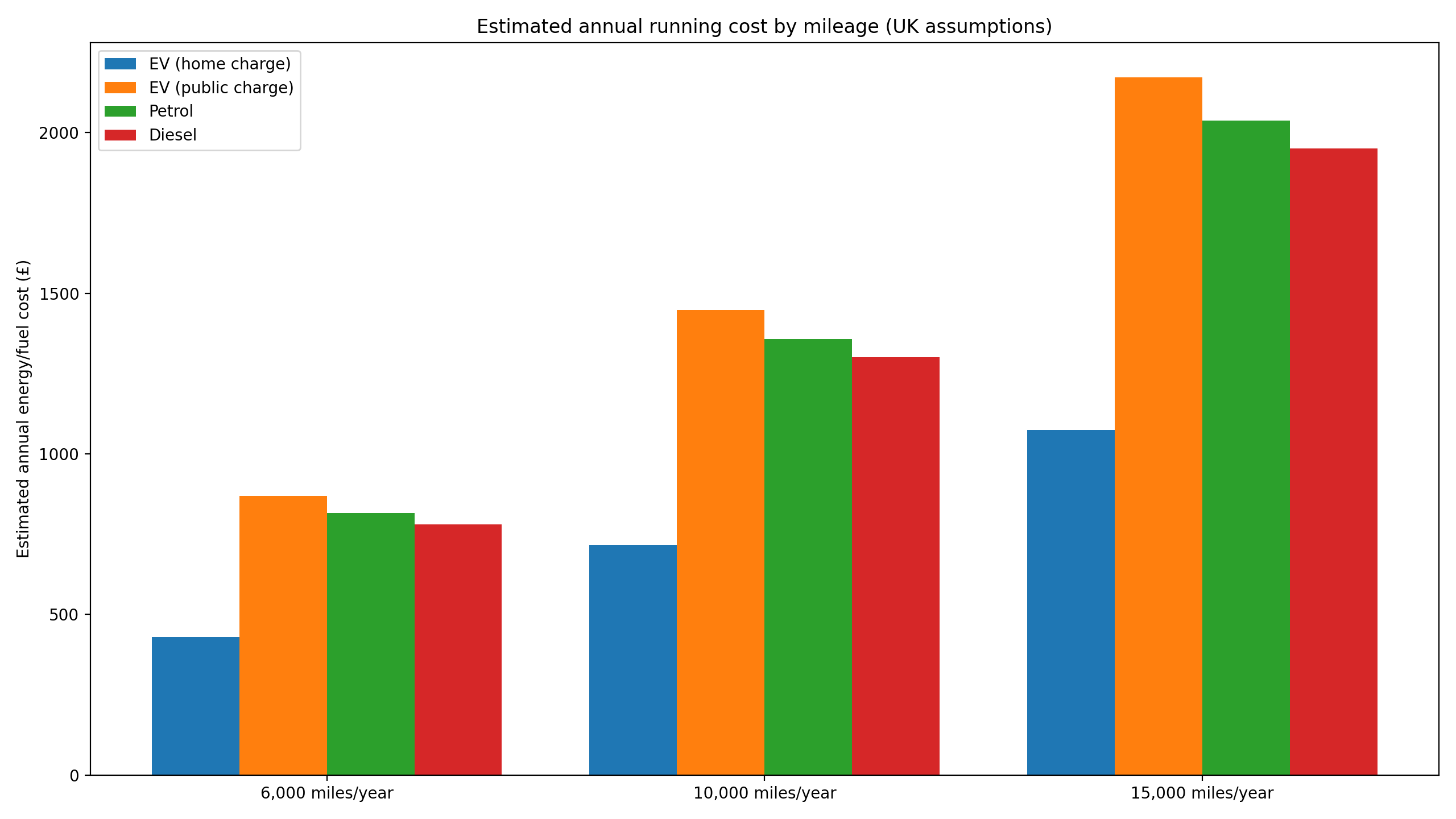
Costs change dramatically depending on how many miles you do and whether you can charge at home.
The chart below compares estimated running costs for 6,000, 10,000, and 15,000 miles per year.
These figures focus on energy and fuel only. They do not include insurance, servicing, tyres, or finance.
EV costs look best with home charging. Public rapid charging can be significantly more expensive.
Five year running cost curve
This curve shows how running costs can add up over five years, using 10,000 miles per year as a realistic
community workload benchmark.
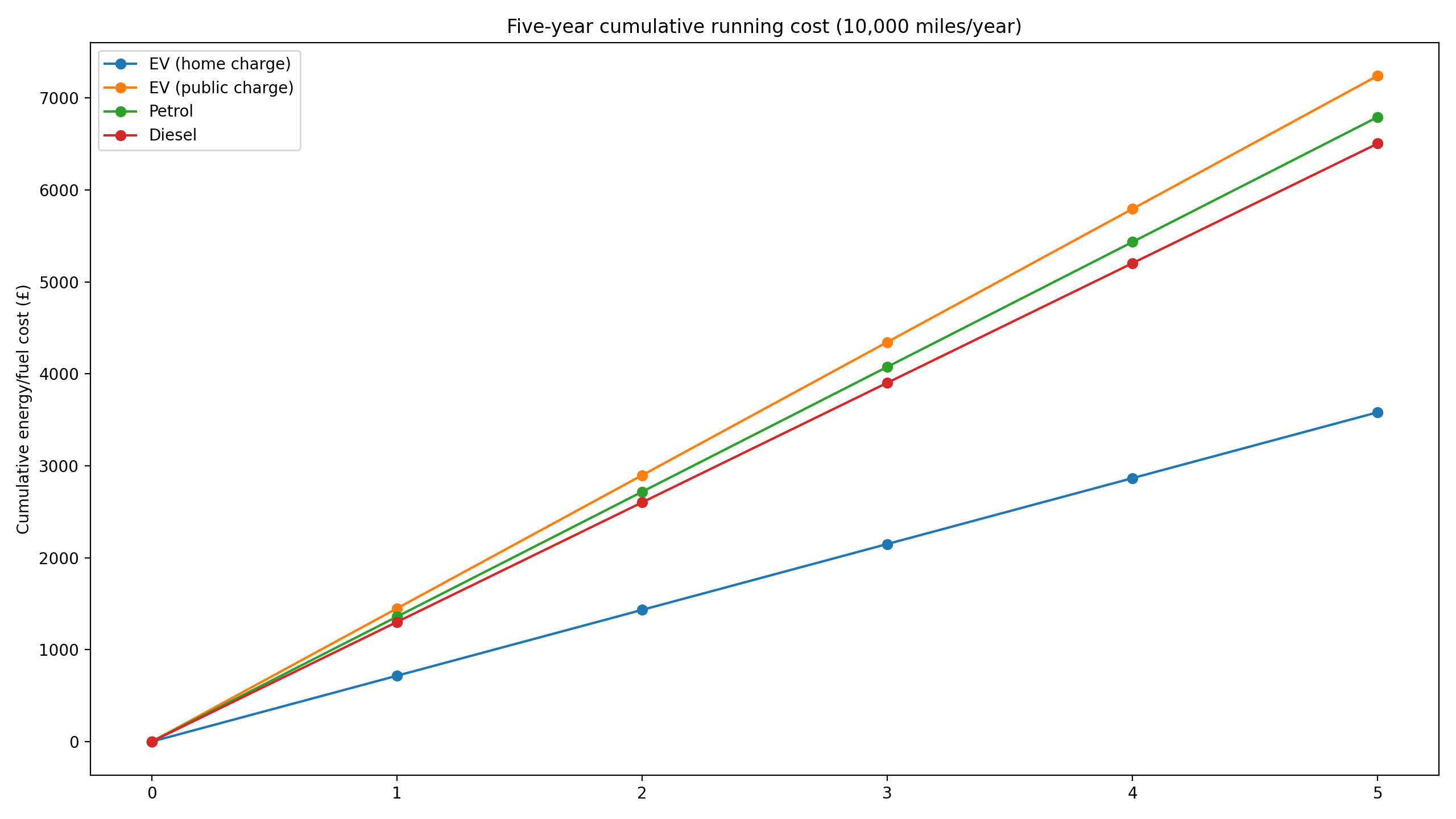
A useful rule of thumb is this. If public charging is a backup, the EV stays affordable. If public charging becomes the routine, the EV becomes unpredictable.
Is it worth it, or is it just a new version of fuel taxation?
This is the part many people are starting to ask, and it is a fair question.
Fuel duty is a major revenue stream, and as EV adoption grows, government will look for replacement mechanisms. Recent reporting has highlighted that future road funding may move towards distance-based approaches for electric vehicles.
That matters because it suggests EV running costs may rise later in the decade. It does not automatically erase the savings advantage of home charging, but it reinforces the idea that the EV “sweet spot” is strongest in the near term, not guaranteed forever.
In plain English, yes, some of this is about replacing petrol and diesel tax in a different form. But the shift is not purely cynical. Roads still need funding, and policymakers are trying to manage fairness between drivers as the vehicle fleet changes.
What policy might change next, and why 2026 sits in a strange middle ground
The ZEV mandate continues, but review pressure is real
The UK’s ZEV mandate sets annual targets for the proportion of new cars and vans that must be zero emission. That usually shows up in everyday life as more EV models entering the market, better lease deals when manufacturers need to hit targets, and more mixed messages in the press that can create hesitation.
Public charging is still a weak point in the UK system
The cost spread between charging networks, and the fact that public charging can be significantly more expensive than home electricity, remains one of the biggest issues for care staff who cannot charge at home.
That is why employer support, charging credits, or clear reimbursement policies can matter more in the care sector than in office-based jobs.
Quick recommendation: what is best for you?
Best choice: Electric car
Home charging is where EV savings become real. For care mileage, it tends to offer the most predictable
running costs over time, especially when paired with fair mileage reimbursement or salary sacrifice.
Best choice: Depends on support
An EV can still work, but only if public charging is occasional, or your employer supports it properly
through higher reimbursement, charging credits, or rota design that reduces miles. Otherwise, a fuel-efficient
petrol or diesel, or a hybrid, may be more practical for now.
So, should a care worker or nurse switch in 2026?
It depends on one question more than any other.
Can you charge at home reliably?
If yes, an EV can be genuinely cost-effective, particularly for people doing steady mileage, and especially if accessed through salary sacrifice or a favourable company car arrangement.
If no, the decision becomes more nuanced. You may still benefit, but you need predictable access to lower-cost charging, or an employer policy that recognises the higher cost of public charging, or a plan to use a hybrid until your charging situation improves.
If you are worried that EVs are “just a tax trap”, the honest view is this: there will likely be new road pricing mechanisms as petrol and diesel decline. That does not mean EVs will stop making sense, but it does mean the smartest approach is to run the numbers with realistic charging habits, not best-case marketing assumptions.

Kate is an enthusiastic and dedicated leader with extensive experience in recruitment and operations management. As Director of CareStaff24, she oversees every aspect of the organisation, ensuring that both carers and clients feel valued and supported.