

Leaving school can feel like you’re suddenly expected to have the next 40 or 50 years figured out.
University? An apprenticeship? A job? More education?
For someone who enjoys working with people and wants a career where they can continue learning, earning and progressing, there is another option worth considering: a career in care.
And care doesn’t have to mean doing the same job for the rest of your working life.
What Could a Lifetime Career in Care Look Like?
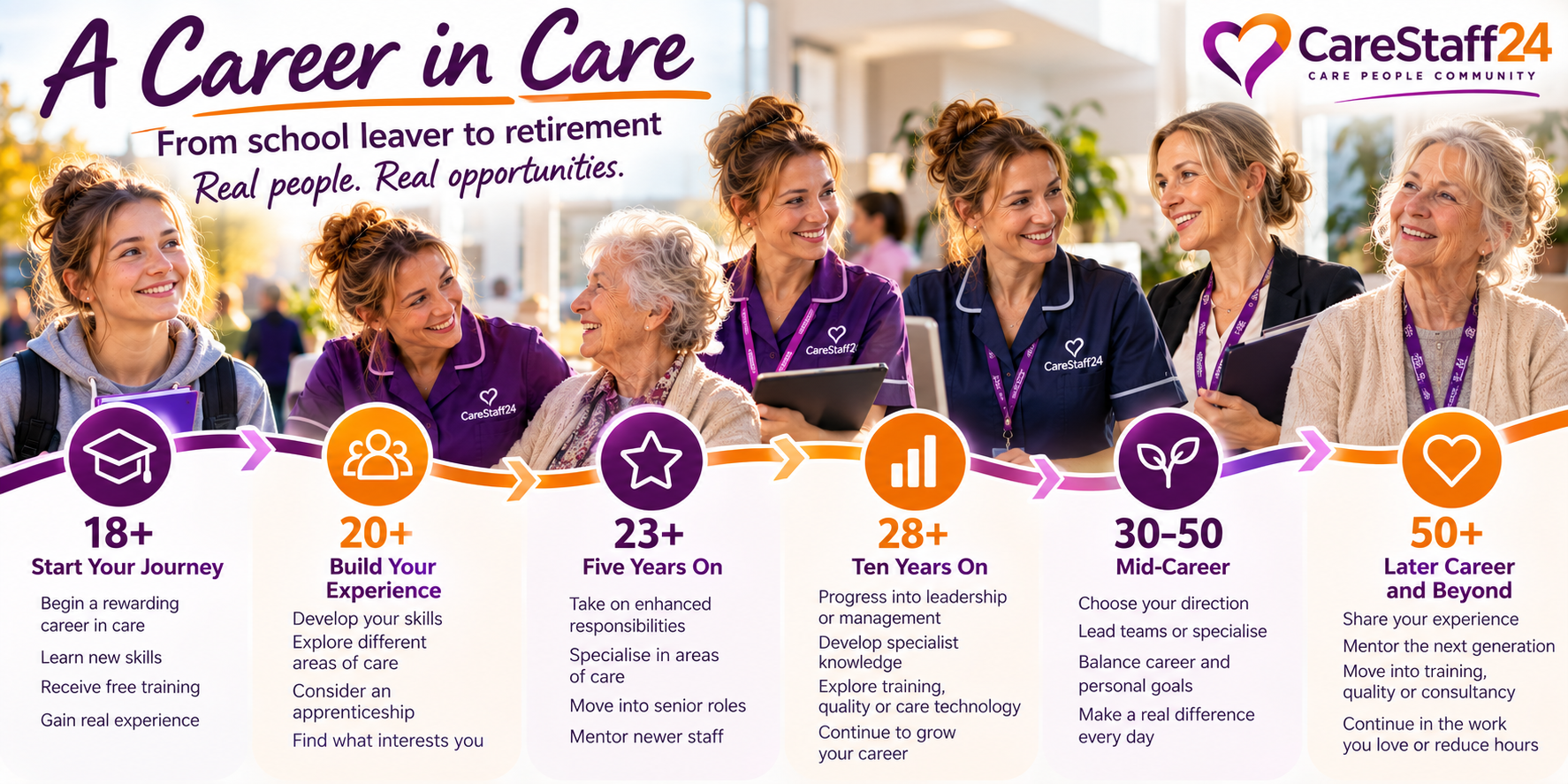
Imagine leaving school at 18 and entering care. Where could you be at 23? At 28? At 40? And what could your career look like as you eventually approach retirement?
There isn’t one answer. That’s one of the interesting things about modern social care.
First Things First: Do You Need Experience to Start?
Not necessarily.
There are several routes into care, including applying directly for suitable roles, apprenticeships, college courses and volunteering.
For somebody leaving school, the important thing isn’t having decades of experience behind them. It’s having the right attitude towards supporting other people and being willing to learn.
Could Care Suit You?
Your Care Career: From School Leaver to Retirement
Everyone’s career develops differently, so the timeline below isn’t a promise or a set of compulsory steps.
Think of it as an example of where a career in adult social care could take you as your experience, interests and responsibilities develop.
START
New to Care → Care or Support Worker
You’re learning what professional care really means and gaining experience supporting people in everyday life.
Your focus:
- Complete induction and essential training
- Learn safe and person-centred working practices
- Build confidence communicating with different people
- Gain practical experience
- Consider an Adult Care Worker apprenticeship or relevant qualification
BUILD
Build Experience & Find Your Strengths
By now, you may understand which parts of care interest you most.
You might begin developing additional knowledge in areas such as dementia care, learning disabilities, autism, complex care, end-of-life care or supporting people to live independently.
You could explore:
- Additional specialist training
- Level 3 learning or apprenticeship opportunities
- Enhanced care responsibilities
- Mentoring newer colleagues
- Different care environments and client groups
5 YRS
Specialist, Enhanced or Leadership Opportunities
Five years into your career, you could have accumulated substantial practical experience and developed a clearer idea of where you want to go next.
You might choose to deepen your specialist skills rather than manage people, or you may decide that leadership suits you.
Possible directions include:
- Enhanced care worker
- Senior or lead care responsibilities
- Supervisor or team leader
- Activity co-ordinator
- Care technology
- Specialist areas of care
10 YRS
Leadership, Management or Advanced Practice
After around a decade in the sector, your career could look very different from your first day.
Depending on your experience, qualifications, interests and opportunities, you might be working towards or within leadership, practice or management roles.
Potential directions:
- Supervisor or leader
- Practice leader
- Deputy manager
- Learning and development
- Quality assurance
- A specialist care career
- Further study towards a regulated profession
GROW
Choose What Success Means to You
Career progression doesn’t have to mean climbing a management ladder.
You might become highly experienced in the kind of care you love providing. Alternatively, you could move towards registered management, training, quality, technology or wider organisational leadership.
Your priorities may change too. Family life, caring responsibilities and personal goals can all influence the direction you choose.
LEAD
Experience Becomes One of Your Biggest Assets
After decades in care, the knowledge you’ve accumulated can become incredibly valuable to other people entering the profession.
You might continue in the work you love, reduce your hours, mentor younger colleagues, support training, move into quality or management, or use your experience in another part of the sector.
The person who once needed somebody to show them what to do may eventually become the person everybody else turns to.
One Career. Many Possible Destinations.
At Five Years: Which Direction Could You Take?
One of the biggest misconceptions about care is that everyone follows the same career ladder.
They don’t.
Stay Close to Care
Become an experienced care professional and continue doing the direct work you enjoy.
Specialise
Develop deeper knowledge in particular areas of care or particular support needs.
Lead People
Move towards supervision, leadership, practice leadership or management.
Keep Studying
Use your experience as a foundation for further qualifications or another health and care profession.
What About Qualifications?
You don’t necessarily need to arrive with a long list of qualifications before starting an entry-level care role.
Learning can continue throughout your career.
Learn the Basics
Training and induction
Gain Experience
Learn while working
Build Qualifications
Develop your knowledge
Choose Your Direction
Specialist or leadership
For example, the Adult Care Worker apprenticeship provides a Level 2 route into the profession, while more advanced learning can support progression into senior, enhanced and leadership roles.
Qualifications are important, but care is also a profession where real-world experience accumulates throughout your working life.
What Could You Have After 10 Years?
Imagine you entered care at 18.
By 28, you wouldn’t simply be somebody who had “worked in care”. You could have a decade of professional experience.
That’s why it’s worth looking at your first care job differently.
You’re not only choosing what you’ll do next month. You could be laying the foundations for what you’ll be doing decades from now.
And What Happens Towards Retirement?
A career isn’t a straight line from 18 to retirement.
Your goals at 55 may be completely different from your goals at 25.
After a long career in care, you may decide you want fewer hours or less physically demanding work. You might discover that passing your knowledge to the next generation is what you enjoy most.
Later-career possibilities could include:
There is something rather special about that journey.
You can enter care needing training and guidance yourself and finish your career with decades of experience that can help guide somebody else taking their very first step.
Where Could Care Take You?
You don’t need to decide today whether you want to become a specialist, team leader, trainer or manager.
You don’t even need to know what you want to be doing in ten years.
You just need somewhere to start.
Start Your Care Career With CareStaff24
If you’re leaving school or college and wondering what comes next, CareStaff24 can help you take your first steps into care.
We offer opportunities across Eastbourne, Hastings and East Sussex, with free training for new staff, flexible shifts, weekly pay and ongoing support.
You can begin by learning the fundamentals, gaining real experience and discovering which parts of care interest you most.
Your Career Doesn’t Have to Be Figured Out Yet.
Start with the first step. Learn. Gain experience. Build your skills. Then decide where you want care to take you.

Your care, your future! We’re here to support both.
At CareStaff24, we’re proud to connect compassionate professionals with meaningful opportunities across East Sussex and beyond. Each job listing reflects our commitment to safer staffing, responsive recruitment, and personalised support.
All applicants are thoroughly vetted, supported through every step, and matched with roles suited to their skills, preferences, and availability. If you have questions about a role or need help applying, our friendly team is just a message away.
Let’s find the right opportunity, together.